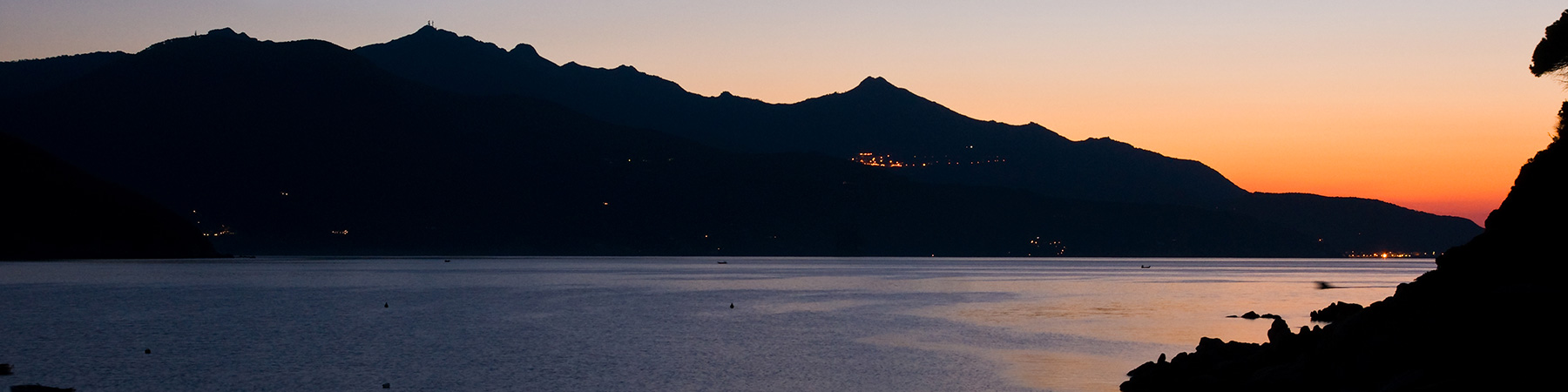
The island offers a marvellous variety of scenery, from small hidden coves
to long sandy beaches; each corner of Elba holds its own special surprise
for
visitors. The island is washed by crystal clear water in every shade of
blue - a paradise for divers.
It's wooded hills make it ideal for hikers, it's panoramic roads so popular
with mountain bikers. Those in search of culture will find it's ancient
churches and museums a pleasant alternative to seaside activities.
The
Island of Elba is the third largest Italian island after Sicily and
Sardinia and is the largest in the
Tuscan Archipelago.
It has recently become part of the Tuscan Archipelago's National Park
together with the islands of Pianosa, Capraia, Montecristo, Giglio and
Giannutri.
Elba has a coastline of 147 km: its main mountain (Monte Capanne) is 1019
metres high, accessed via pathways or by a panoramic cable car.
BRIEF INFORMATION

Measuring 224 square kms, Elba is situated 10 kms from the mainland
with an excellent ferry boat service taking only one hour from Piombino to
Portoferraio (the island's main town).
Elba
has approximately 30.000 inhabitants, of these, 11.000 live in
Portoferraio. The island is divided into 8 administrative "Communes".
It has an asphalt road network of 160 km and 80 km of panoramic "macadam"
roads.
The climate is always mild with a middle annual temperature of ca.
16°; the medium in the winter is about 10° degrees, 14° in
spring, 23° degrees in summer and 17° degrees in autumn. The
medium water-temperature in April is always about 19° degrees,
20° in May, June about 24°, 26,8° degrees in July, in August
27,3°, September 25,5° degrees and October 23,1° degrees.
Already in acient times Elba's destiny was always determined by two
factors: its strategic position and the richness of its mineral resources.
Due to these characteristics, it was often the object of conquest for the
various powers along the Mediterranean. For the Etruscans and the Romans
Elba represented an inexhaustible source of riches and the iron from Elba
contributed to the prospering of their civilazation.
During the Medieval period Elba was dominated by Pisa. The remains of some
important and striking defensive structures testify the importance of
possessing the island. The Appiani Lordship followed, as did the attentions
of Cosimo de Medici, who built "Cosmopoli" on top of the ruins of the Roman
city of Fabricia - now the capital Portoferraio - and had it surrounded
with the impressive walls that saved the inhabitans from many pirate raids.
The Spaniards settled in Porto Azzurro and they too made sure to construct
defenses on their territory - the imposing San Giacomo Fort still dominates
the pleasant landscape.
In the more recent history, the period that made this island famous and
placed it on the world map was the brief
exile of Napoleon
, who stayed here for 10 months prior to his 100 days adventure which was
finished in Waterloo. Bonaparte left a significant mark of his short reign:
important reforms and buildings like his Townhouse "Villa dei Mulini" in
Portoferraio and his impressing summer residence "San Martino" - which are
now museums and can be visited.
The island first opened to tourism soon after 1950 but has managed to
preserve it's waters, flora and fauna thanks to its local administration
and inhabitants.
A tiny airport services the island, permitting only small planes to land
from a few privileged european cities. Most visitors arrive by car, others
by train travelling to Piombino Marittima station which is very close to
the ferry departures.